Every creator economy report repeats the same statistic in a different costume: the market is worth over $200 billion, AI adoption is near universal, the future is bright. What most of them skip is this: producing more content and earning more money are two different problems.
Roughly 86% of creators already use generative AI in some form, per Adobe's 2025 creator survey. Editing, captioning, repurposing one video into five platforms worth of content, none of that is a bottleneck anymore. A creator can shoot once and walk away with a week of posts.
Income has not kept pace. A 2026 creator commerce benchmark shows sponsored deals still make up about 59% of creator revenue, with affiliate income at roughly 8% and growing. That is a strange split, given that influencer recommendations reportedly drive purchase decisions for 88% of consumers who acted on one, per Nielsen.
The Part of the Workflow AI Actually Forgot
Ask a mid-tier creator what eats their week and editing rarely tops the list anymore. Tagging does. A typical fashion or beauty post features three to six items: the top, the shoes, the bag, the lip color. Each one needs its own link.
Turning every item into a working affiliate link means, for each post:
- Finding the exact retailer page for that product
- Generating the commissionable link
- Attaching a product card manually
- Repeating it for every other item in frame, every day
Reddit and Pinterest's own creator forums are full of the same complaints: links that break after a retailer changes its URL structure, products that never got tagged because the creator ran out of time, and captions that cover one item while three others in the same photo earn nothing.
Even top platforms that are most associated with creator commerce, still requires manual product linking through a bookmarklet or app. Its approval process is selective enough that creators openly compare rejection stories online despite decent engagement, and there is a lasting misconception that only mega-influencers with 50,000-plus followers ever get in.
This is the real constraint on creator income, and it has nothing to do with creativity. A creator can be an excellent stylist and photographer and still leave money on the table because half the outfit in a photo was never linked to anything.
Why Visual Recognition Changes the Math
Computer vision solved this exact problem for search engines before it solved it for creators. Google Lens processes roughly 20 billion visual searches a month, with about 4 billion tied to shopping intent. Pinterest Lens sees over a billion monthly uses, converting at notably higher rates than text search on the platform.
People already point a camera at something they want and expect a purchase link back. That behavior started with shoppers, not creators.
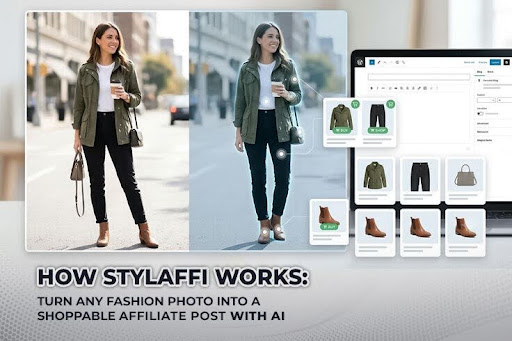
What changes when the same recognition runs on the creator's side of the post is timing. Instead of a follower screenshotting an outfit and hoping a reverse image search finds it, identification happens the moment content is uploaded.
A photo of someone in a Ray-Ban Wayfarer does not need a caption naming it. The system recognizes the frame shape and brand markers, matches it against a product database fed by affiliate networks, and attaches a working link automatically, for that item and every other identifiable one in the shot.
That shift, from "tag what you remember" to "the system tags what it sees," is the real transformation here. Not smarter captions. A commerce layer that stops depending on a tired creator's memory at 11pm.
Why 2026 is Different from 2022
A few numbers explain the urgency:
- Creator-driven affiliate revenue grew 47% year over year in 2026, now near a quarter of total affiliate spend, up from about 11% in 2022
- Creators with 10,000 to 100,000 followers generate close to four times more attributable affiliate revenue per follower than traditional display affiliates in comparable categories
- That gap is widest in beauty, fashion, and gaming
At the same time, the channels creators relied on for traffic are weakening. Most affiliate publishers cite dependence on Google search as their biggest structural risk, since more queries now get answered inside AI Overviews instead of sending a click anywhere. Cookie windows are shrinking too, with more programs moving from 30-day attribution to 7-day.
Affiliate income is becoming a bigger share of creator pay right as the old plumbing, search traffic and long cookie windows, gets weaker. The platforms that win will generate commissionable links directly from content, independent of whether a follower ever searches Google or clicks within an old attribution window.
What This Means for Brands
Every social post a creator makes today already contains unlinked, unmonetized product impressions, because manual tagging cannot keep pace with content volume. Automated recognition converts that dormant inventory into trackable placements without a brand's marketing team running a single new campaign.
It also surfaces better data. When recognition runs on every post, not just the items a creator chose to caption, a brand sees which products actually get worn and styled organically, not just which ones get name-dropped. That kind of unprompted signal is closer to real market demand than anything a manual tagging system was ever built to capture, and a brand gets it without running a survey or a paid campaign.
What to Check Before Picking a Platform
The useful question is no longer "does this use AI," since every commerce tool claims that now. Sharper questions to ask:
- Does it tag every identifiable item, or only the one a brand paid to promote?
- Does the link generate at upload, or does it still need a bookmarklet or manual save step?
- Does a broken retailer URL get re-mapped automatically, or does the link just die?
- Is approval based on follower count, or on content quality and category fit?
- How long is the attribution window, and does it hold up across a multi-item cart?
Most tools answer at least one of these poorly. That is less a knock on any single platform and more a sign of how recently real-time, multi-item recognition became accurate enough to run at the scale of an actual creator feed.
The Bigger Picture
AI in the creator economy is often framed as an editing shortcut, and for a while that was fair. The next phase looks different. The tools that matter most now are not the ones that make a video look better in ten seconds.
They are the ones that make sure nothing a creator posts goes unmonetized, that every product in frame becomes a real, trackable link the moment it publishes, and that income finally scales with what a creator actually makes, not how much manual tagging they had time for.
That is the shift platforms like Stylaffi are built around: AI that enhances a post and automatically recognizes and links the products inside it, so commerce happens in the same motion as the content, not as a separate chore afterward.
Ready to Maximize Your Creator Income?
Join Stylaffi and experience the future of creator monetization. Our AI automatically tags every product in your content, turning every post into a revenue opportunity.
Get Early Access